
Two-Shot Injection Molding for Integrated Plastic Components
PPMolding specializes in two-shot injection molding for parts that combine distinct plastics, colors, or material properties in a single manufacturing cycle. Create rigid substrates, soft-touch surfaces, integrated seals, and high-quality visual details without separate assembly.
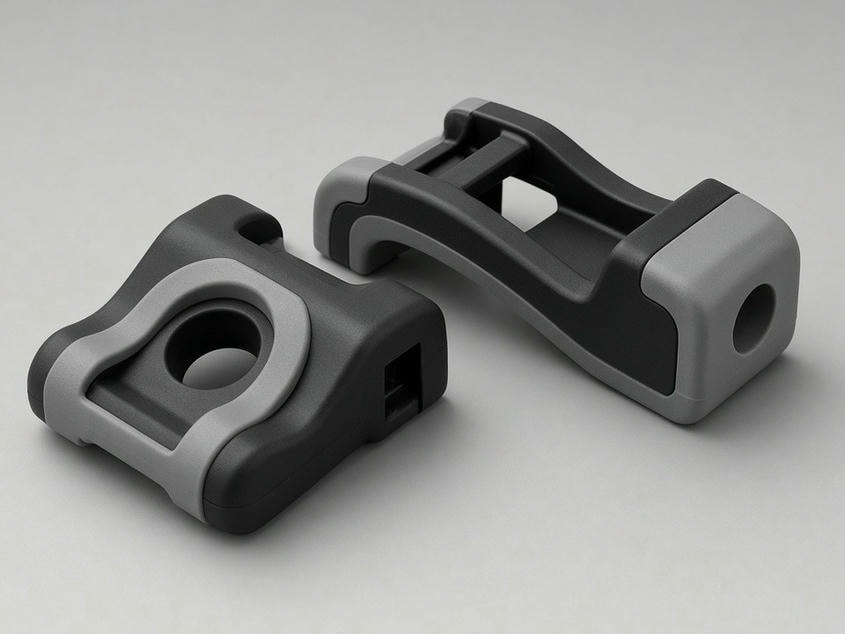
Why two-shot molding
Streamline production through multi-material integration
Traditional production may require separate molds and subsequent assembly to combine materials or colors. Our two-shot process molds the second material directly onto the first while the part remains in the machine, helping product design engineers and brand teams simplify production while improving the finished product.
Reduced assembly costs
Eliminate manual or robotic assembly steps, reduce labor requirements, and lower the risk of alignment errors.
Improved structural bonding
The in-process bond can provide stronger integration than mechanical snaps or adhesive bonding.
Enhanced aesthetics
Produce crisp color transitions and tactile surfaces that are difficult to replicate through post-molding assembly.
Integrated sealing
Mold TPE or TPU seals directly into rigid housings for airtight or watertight performance without extra gaskets.
Technical capabilities
Designed for repeatable, high-volume production
We use rotary and transfer mold technologies for small to medium-sized components and production programs where consistency, material performance, and efficient cycle times are essential.
| Parameter | Typical capability | Application guidance |
|---|---|---|
| Material combinations | Hard/Hard or Hard/Soft, including PC/ABS and PP/TPE | Select compatible materials according to bonding, flexibility, and chemical requirements |
| Color quantity | Two or more colors per part | Useful for visual differentiation, brand details, and functional controls |
| Equipment type | Rotary, transfer, and custom two-shot systems | Matched to component geometry, material sequence, and production volume |
| Mold structure | Rotary / transfer / custom tooling | Supports integrated substrates, overmolding, seals, and controlled transitions |
| Product size | Small to medium-sized components | Final sizing is evaluated from CAD data, machine capacity, and mold layout |
| Production efficiency | Medium to high-volume production | A single integrated cycle can reduce assembly labor and handling |
| Tolerance | Down to ±0.05 mm, subject to part design | Confirmed during DFM review and dimensional validation |
| Surface finish | Polish, texture, and matte | Selected to support appearance, grip, and brand requirements |
| Common industries | Consumer electronics, automotive, medical, and household appliances | Suitable where material performance and high-volume consistency are critical |
Applications
Built around product performance and user experience
Our team collaborates with product designers, mechanical engineers, and brand owners from concept development through full-scale production.
01 / Consumer electronics
Comfort, grip, and protection
Create housings with integrated non-slip grips or vibration-dampening seals while maintaining clean visual transitions.
02 / Automotive controls
Clear feedback and coding
Manufacture buttons, switches, and interior interfaces that combine distinct colors with tactile feedback.
03 / Medical devices
Rigid structure with soft sealing
Develop components that combine structural plastics with biocompatible soft-touch seals where the design requires it.
04 / Household appliances
Durability with refined finish
Produce ergonomic handles and control panels that balance repeated use, tactile comfort, and high-end aesthetics.
Engineering guidance
Selecting the right molding strategy
Two-shot molding is not required for every project. A simple single-material part may be more cost-effective with standard injection molding. It becomes the logical choice when integration, sealing, aesthetics, or assembly volume justify specialized tooling.
Discuss Your DesignHigh assembly volume
Specialized two-shot tooling can be offset by eliminating ongoing assembly labor and handling.
Critical sealing requirements
A permanent interface between a rigid frame and soft component can support leak-resistant performance.
High visual quality
Integrated color and material transitions help avoid the parting lines or gaps associated with separate components.
Early DFM review
We evaluate draft angles, wall thicknesses, material compatibility, adhesion, and cycle time using your CAD files.
Frequently asked questions
Practical answers for your next project
Start your project
Expedite your project with PPMolding
Engage us during the early design phase for DFM feedback, material selection guidance, transparent lead times, and a practical path from concept to full-scale production.
Send your project requirements and 3D files for an initial evaluation. We can help assess whether two-shot molding is the right strategy for your component.
Request a quote
Share your design requirements and our team will review the best route for your application.