
Precision plastic component manufacturing
Precision Injection Molding for Tight-Tolerance Applications
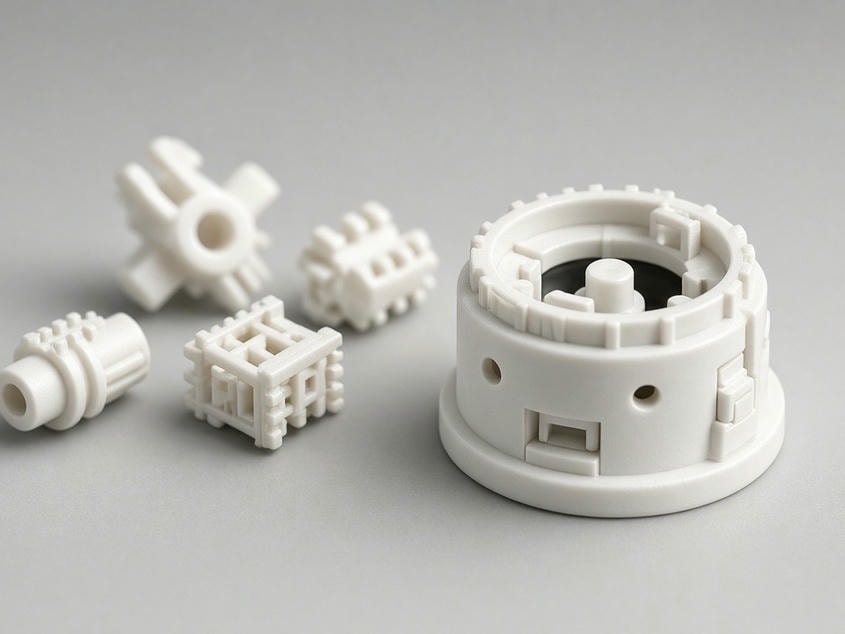
PPMolding specializes in precision plastic components where dimensional accuracy and geometric stability are critical. We support engineers and procurement teams requiring consistent, repeatable parts for functional, mechanical, and electronic applications.
±0.02
Typical lower tolerance range, mm
32+
Potential cavity configurations
<1 g
Small-part capability
7+
Engineering resin families
Precision at every stage
Core capabilities for demanding assemblies
Our manufacturing process manages the variables that influence part quality, from resin shrinkage and gate design to thermal cooling balance. This helps specifications remain consistent from the first shot through the final production run.
Built for functional performance
Precision molding is applied to small, complex, and mechanically demanding plastic parts across medical, electronic, industrial, and automation programs.
| Parameter | Typical capability or requirement |
|---|---|
| Dimensional accuracy | Typical tolerance of ±0.02–±0.05 mm |
| Minimum wall thickness | Project dependent; evaluated against resin, flow length, geometry, and tooling design |
| Material grades | POM, PA, PBT, PC, PPS, PEEK, and ABS |
| Part weight | Less than 1 g to several hundred grams |
| Cavity configuration | 1 to 32+ cavities |
| Surface requirements | Fine polish to industrial texture, with gate vestige review |
| Inspection items | Critical dimensions, GD&T, wall thickness, surface quality, and material properties |
| Typical applications | Medical components, connectors, sensor housings, gears, bushings, and wear parts |
| Production volume | Low to high volume |
| Secondary processes | Insert molding, post-mold machining, and assembly |
Engineering-led process
Manufacturing decisions made around your part requirements
Before production begins, our team reviews the mechanical requirements and the variables that affect stability. This approach supports thin-wall connectors, complex gears, miniature components, and other high-performance geometries.
Mold construction
Hardened tool steels and precision-engineered cooling channels help control warping and maintain geometric stability.
Material conditioning
Moisture control is managed for hygroscopic materials such as PA and PEEK to protect structural integrity.
Gate and venting design
Flow paths are optimized to reduce internal stress and support complete cavity packing across complex geometries.
Parameter stability
Injection pressure, cycle time, and mold temperature are monitored to support consistency across production batches.
Material expertise
Select the resin around the performance requirement
Component performance often depends on the resin’s thermal, chemical, mechanical, electrical, and wear characteristics. We process engineering plastics for specialized industrial applications.
Discuss material selectionPOM and PA
Used for high-wear components, gears, and snap-fit assemblies.
PC and ABS
Suitable for high-impact housings and clear optical components.
PPS and PEEK
Selected for high-temperature environments, medical devices, and chemically demanding industrial applications.
PBT
Preferred for electronic connectors requiring high dielectric strength and dimensional stability.
Built for demanding sectors
Reliable components for complex systems
Our facility supports the structural and functional parts that keep medical, electronic, automation, and mechanical systems operating reliably.
Medical and laboratory
High-precision housings and fluid handling components.
Electronics
Miniature connectors, sensor housings, and insulating brackets.
Robotics and automation
Precision gears, linkages, and structural frames.
Mechanical engineering
Custom bushings, spacers, and wear-resistant moving parts.
Validated quality
Inspection that verifies the design intent
Precision is not only a tooling objective. Each project follows an inspection protocol designed to confirm that production parts match the approved design files.
- ✓Critical dimension validation and GD&T compliance
- ✓Wall thickness consistency across the molded component
- ✓Gate vestige removal and surface finish quality
- ✓Material property verification through standard batch testing
Inspection tools and feedback
CMM and optical inspection tools are used to assess critical dimensions, complex geometry, and surface conditions. Findings are fed back into the process to support repeatable production.
CMM
Coordinate-based dimensional verification
Optical
Non-contact review of detail and finish
Technical partnership
From DFM review to volume production
PPMolding focuses on the technical requirements of your design. Clear DFM feedback helps identify risks such as sink marks, voids, and flash before they affect high-tolerance production.
01
Review
Analyze CAD geometry, drawings, material specifications, tolerances, and production volume.
02
Optimize
Recommend mold, gate, cooling, and process adjustments that support part stability.
03
Scale
Transition from prototype requirements to repeatable low- or high-volume manufacturing.
Technical questions
Precision molding answers
Share your part requirements with the engineering team for a project-specific review.
Start a conversationRequest a quote
Send your precision molding project for review
Share your 3D CAD files, technical drawings, material specifications, and volume requirements. Our engineering team will review the geometry and prepare a detailed manufacturing proposal.
Email: info@plasticpartsmolding.com
Address: