
Robotics & Automation Plastic Components
PPMolding manufactures custom plastic components for robotics, automation equipment, and smart machinery. From lightweight housings to precision structural and functional parts, we support projects from prototype through repeatable production.
1 g–5 kg
Typical part weight
50–1,000 t
Injection capacity
±0.05 mm
Typical tolerance
3–6 weeks
Typical tooling lead time
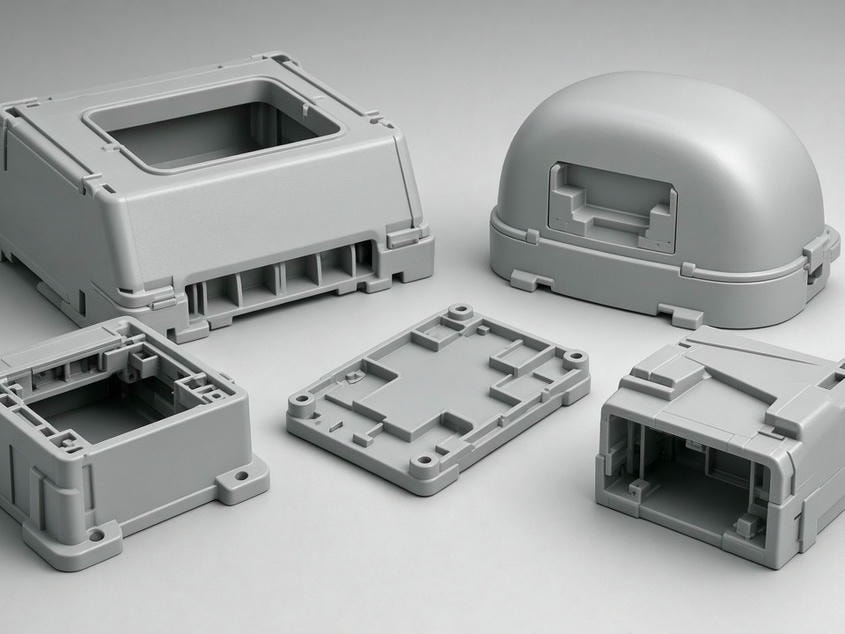
One manufacturing partner
Mold design, molding, secondary processing, assembly, and volume production under one coordinated workflow.
Built for product iteration
Plastic parts that keep robotics programs moving
Robotics products combine moving mechanisms, sensors, electronics, wiring, and user-facing surfaces in compact assemblies. Each plastic component must balance dimensional control, low weight, impact resistance, assembly accuracy, appearance, and production cost.
Lightweight by design
Ribbed structures, optimized walls, integrated features, and appropriate engineering plastics can reduce moving mass without overlooking stiffness or fastening strength.
Precision where it matters
Critical mounting points, sensor openings, snap-fits, connector locations, enclosure joints, and functional interfaces receive focused tolerance review.
Fast development cycles
Prototype, bridge, production, family, insert, overmolding, hot-runner, and cold-runner tooling options help match the tooling strategy to design maturity.
Application coverage
Components for robotic and automated equipment
The part design, resin, mold construction, and production process are selected according to the component’s function rather than appearance alone.
Discuss your application| Application | Typical plastic components |
|---|---|
| Collaborative robots | Arm covers, joint housings, sensor covers, end-effector components |
| Industrial robots | Protective guards, cable covers, mounting brackets, control housings |
| Mobile robots and AGVs | Chassis covers, battery enclosures, bumpers, sensor windows |
| Service robots | Exterior shells, control panels, handles, display bezels |
| Robotic grippers | Finger covers, jaws, brackets, soft-touch contact parts |
| Machine vision | Camera housings, lens covers, sensor mounts, protective enclosures |
| Automated production lines | Guides, covers, guards, fixtures, cable-routing components |
| Smart equipment | Enclosures, buttons, connectors, interface panels, structural supports |
Product scope
From robot housings to functional plastic parts
Send drawings, 3D models, samples, or product requirements for a practical manufacturing review.
01 / Protection
Robot housings and covers
Multi-piece enclosures protect electronics, motors, sensors, batteries, and control systems. Features can include bosses, snap-fits, screw posts, ventilation, gasket interfaces, and cable exits.
Matte, textured, polished, painted, printed, and laser-marked finishes
02 / Structure
Structural plastic parts
Brackets, frames, carrier plates, support arms, base components, and equipment panels can use ribs, bosses, locating pins, snap-fits, captive features, interlocking edges, and metal inserts.
Geometry and resin are reviewed against load, temperature, and assembly conditions.
03 / Function
Functional components
Cable guides, sensor brackets, gear covers, belt guards, sliding guides, buttons, connector housings, bumpers, spacers, alignment parts, tooling, and fixture components.
POM, PA, PBT, PPS, PC, ABS, PC/ABS, TPE, TPU, and other thermoplastics can be considered.
Engineering approach
Reduce weight without losing function
Weight reduction can support easier robot handling, reduced moving mass, and compact equipment packaging. Stiffness, impact resistance, fastening strength, and service life remain part of the design decision.
- ✓ Optimize wall thickness by function
- ✓ Use ribs instead of solid sections
- ✓ Integrate mounting and locating features
- ✓ Combine molded parts into subassemblies
- ✓ Add localized metal inserts where justified
Technical reference
Robotics plastic parts parameters
These ranges represent typical capabilities. Actual limits depend on part geometry, material, tolerances, mold design, and production volume.
| Part type | Housings, covers, brackets, structural parts, guards, sensor mounts, functional components |
|---|---|
| Part weight | Approximately 1 g to 5 kg |
| Injection machine size | Approximately 50 to 1,000 tons |
| Mold cavities | Single cavity to multi-cavity |
| Mold options | Prototype, bridge, production, family, insert, overmolding, hot runner, cold runner |
| Typical tolerance | Approximately ±0.05 mm; tighter tolerances may be reviewed by design |
| Materials | ABS, PC, PC/ABS, PP, PA, POM, PMMA, TPE, TPU, PBT, PPS, PEEK, and specified grades |
| Surface and color | SPI finish, texture, polishing, matte, custom finishes, and color matching |
| Insert and overmolding | Metal inserts, threaded inserts, pins, terminals, rigid plastic with TPE or TPU where suitable |
| Secondary processing | Printing, laser marking, painting, welding, machining, bonding, and assembly |
| Drawing formats | STEP, STP, IGES, IGS, X_T, STL, DWG, DXF, PDF |
| Production volume | Prototype, low-volume, medium-volume, and mass production |
Tolerance requirements should be assigned to functional features rather than applied uniformly to every surface. This can help control tooling and production cost while protecting critical fits and interfaces.
Material selection
Resins matched to the working environment
Selection should reflect mechanical load, operating temperature, friction, impact exposure, electrical requirements, surface expectations, reinforcement, flame performance, and certification needs.
| Material | Suitable uses |
|---|---|
| ABS | General housings, covers, control panels |
| PC / PC/ABS | Impact-resistant covers, electronic housings, enclosures |
| PP | Lightweight covers, containers, guards |
| PA / Nylon | Brackets, clips, gears, structural parts |
| POM | Low-friction guides, gears, bearings, sliding parts |
| TPE / TPU | Flexible covers, bumpers, grips, seals |
| PBT / PPS | Electrical, dimensionally stable, and demanding components |
| PEEK / PMMA | High-performance parts, transparent covers, display windows |
Development workflow
From RFQ to repeatable production
Robotics products frequently change during development. We review the tooling strategy alongside the design so revisions can be managed without unnecessary rework.
RFQ and review
Review 3D models, drawings, material, quantity, application, and delivery requirements.
Part and tooling evaluation
Assess geometry, mold construction, tolerances, surface requirements, and secondary operations.
Mold and sample validation
Develop suitable tooling, mold initial parts, and check dimensions, appearance, assembly, and function.
Production and delivery
Prepare stable molding, inspection, finishing, assembly, packaging, and shipment workflows.
Engineering checks
- Wall thickness and material flow
- Draft angles and ejection
- Ribs, bosses, and snap-fits
- Parting lines and visible surfaces
- Gate and weld-line risks
- Shrinkage and dimensional stability
- Undercuts and side actions
- Assembly clearances
Integrated processes
Insert molding can integrate threaded bushings, pins, terminals, and structural connection points. Overmolding can combine rigid plastic with TPE or TPU for handles, gripper contacts, bumpers, cable exits, and seals.
Ultrasonic welding, heat staking, CNC machining, printing, laser marking, painting, adhesive bonding, assembly, and custom packaging are also available.
Project fit
A practical fit for evolving automation programs
New robot platforms
Prototype to pilot production support
Custom equipment
Enclosures, brackets, and functional parts
Design revisions
Flexible tooling for validation changes
OEM programs
Low, medium, and mass production
What should be included in an RFQ?+
Please include 3D CAD files, 2D drawings, required resin and grade, estimated prototype and annual quantity, surface and color requirements, critical dimensions, insert or overmolding needs, assembly or packaging requirements, target delivery date, and destination.
When is prototype or bridge tooling appropriate?+
Prototype or bridge tooling may suit early validation, low-volume programs, or designs that are still being refined. Production tooling is recommended when the design, material, and expected demand are sufficiently stable.
Can complete plastic subassemblies be supplied?+
Yes. A project can start with one component or a complete plastic subassembly, including welding, insert installation, marking, assembly, and packaging.
Request a quote
Let’s review your robotics plastic component
Send your part files and project details to request a manufacturing review from PPMolding.
Email: info@plasticpartsmolding.com
Address:
- ✓ STEP, STP, IGES, IGS, X_T, or STL files
- ✓ DWG, DXF, or PDF drawings
- ✓ Material, quantity, finish, and tolerance requirements
- ✓ Insert, overmolding, assembly, and packaging needs